
Short answer. Car seats go mouldy in Malaysia because the foam inside them stays wet long after the surface feels dry. Most moulds need at least 70 per cent relative humidity. Inside damp foam it is close to 100 per cent, whatever the weather is doing outside. The heat in a parked car makes this worse rather than better, because it dries the surface fast and seals the moisture underneath.
Why do car seats go mouldy in Malaysia?
Mould needs moisture, a surface it can feed on, and time. A car seat supplies all three, and a Malaysian car supplies the first one far longer than people expect.
According to the Designing Buildings guidance on mould growth, the majority of moulds need at least 70 per cent relative humidity to thrive, and outbreaks happen mostly on porous materials holding persistent moisture. Seat foam is as porous as a material gets.
Here is the part that catches people out. The question is not whether the weather is humid enough. Inside a cushion that is still damp, the humidity at the fibre surface is effectively 100 per cent. A sealed car with one damp seat in it has already built the conditions mould needs, on a dry day, in the sun.
The heat does not help, and the figures say why
The instinct is reasonable. Park it in the sun, let the heat bake it out. A study by McLaren, Null and Quinn, published in the journal Pediatrics in 2005, measured what a parked car actually does. It is summarised by Stanford Medicine and the paper itself is here.
| What they measured | Result |
|---|---|
| Rate of heating | About 3.2°F, roughly 1.8°C, every five minutes |
| First half hour | 80 per cent of the total rise happens in it |
| After an hour | An average of 41°F above outside, roughly 23°C, across outside temperatures of 72 to 96°F |
| Windows cracked open | An inch and a half made no significant difference to either the rate or the final temperature |
On an ordinary Malaysian afternoon that puts a cabin well past 50 degrees Celsius.
That heat is real and it does dry things. The problem is what it dries, and in what order. It drives moisture out of the top few millimetres quickly, which is the part you touch, so the seat feels dry. The foam underneath is insulated by the fabric above it and by its own thickness, and it holds water for far longer. What you end up with is wet foam under a dry crust, inside a hot sealed box.
That is not a recipe for drying. It is a recipe for mould, and it explains the thing most people find baffling: mould usually appears a week or two after the car was cleaned, not before.
Can mould on car seats be removed, or is the seat finished?
It can be removed, and the seat is usually fine. Mould on upholstery is a surface and near surface growth on the fibres, not damage to the foam underneath, as long as it is caught before it has been growing for months.
Two steps, and the order is the point. First the growth and the soil feeding it are cleaned out with a chemical made for car upholstery. Then the fabric is treated with NADCC, sodium dichloroisocyanurate, a chlorine releasing disinfectant used by organisations including MSF and UNICEF for disinfecting surfaces and drinking water.
Then the seat is dried properly, because mould that is killed and left damp simply comes back.
One safety point if you are doing this yourself. Chlorine based disinfectants must not be mixed with acids or with detergent. The CDC puts the chemistry plainly: when sodium hypochlorite and an acid are mixed, chlorine gas is released. Urine is mildly acidic. So if a seat has been urinated on, do not reach for bleach or a chlorine tablet. In a professional job the cleaning and the disinfecting are separate steps with a rinse between them, which is exactly why they are separate steps.
What is car interior cleaning, and what does it include
Car interior cleaning means cleaning the surfaces people touch and sit on rather than the paintwork. Seats, headrests, door cards, floor carpets, boot lining, and the plastics around them.
The part that matters is not the list of surfaces, it is whether the water goes back out. A proper job is a sequence, and the order is not decorative:
- Dry vacuum first. Grit and dry soil have to come out before any liquid goes in, or the water turns dry dust into mud and pushes it deeper
- Hot steam disinfecting. Heat on contact, and it reaches into the weave rather than sitting on it
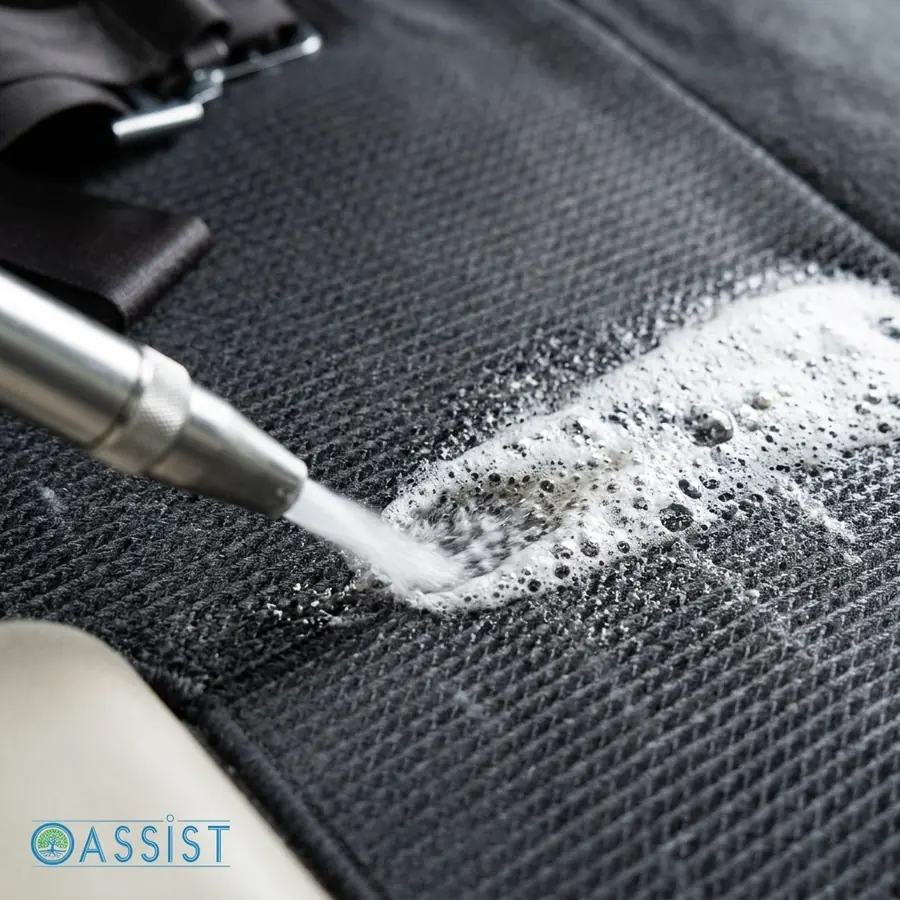
- Wet shampoo and extraction. Solution in, then drawn back out carrying the soil it has loosened. This is the stage a towel cannot do
- Leather only: polishing and a protection oil. Leather that is cleaned and not fed will crack sooner than leather that was never cleaned
The procedural standard for this work is ANSI/IICRC S300, whose second edition was published in 2025. It covers fibres and construction, pre and post cleaning inspections, cleaning methods, leather, spot removal and fabric protectors. The existence of a published standard is itself the point: there is a right order, and the differences between fabric and leather are not a matter of opinion.
Why the smell comes back when the weather turns
A musty smell that disappears and then returns is almost always moisture, not dirt.
Where urine is involved there is a second mechanism. As urine dries and breaks down it leaves alkaline salts behind, and those salts are hygroscopic, meaning they pull moisture out of the air. Cleanfax, the cleaning and restoration trade magazine, puts it plainly: in all but the driest environments that salt residue holds enough moisture to set off a moisture meter.
So the residue never properly dries out. It sits in the foam staying slightly damp, which is why a clean that looked successful on day one can fail a month later. The smell was not removed. It was temporarily not detectable.
There is a quick way to tell moisture from the air conditioning. If the smell is worst in the first thirty seconds after you start the car and then fades, that is the air conditioning evaporator. If it is there all the time and gets stronger on wet days, that is the upholstery.
Air fresheners solve neither. They add a second smell on top of the first.
Can you clean car seats yourself?
Yes, and for fresh surface soiling it works. There is no reason to pay somebody to lift a coffee splash off a seat you can reach.
Where it stops working is the point at which the problem is below the surface. The tell is a brown outline appearing around the patch you cleaned once it dries, sometimes called a tide mark or a water ring. Malay speakers have a better name for it: kesan peta dunia, the world map stain.
That outline is not new dirt. It is old dirt that moved. Wetting one area carries soil down into the foam. As the water evaporates it travels back up to the surface and brings the soil with it, but it does not arrive evenly. It concentrates at the edge of the wet area, at the boundary between damp and dry, and dries there. The line is a map of exactly how far you wet.
Which is why spraying more and scrubbing harder makes it worse. Every repeat pushes more soil in and draws a new boundary.
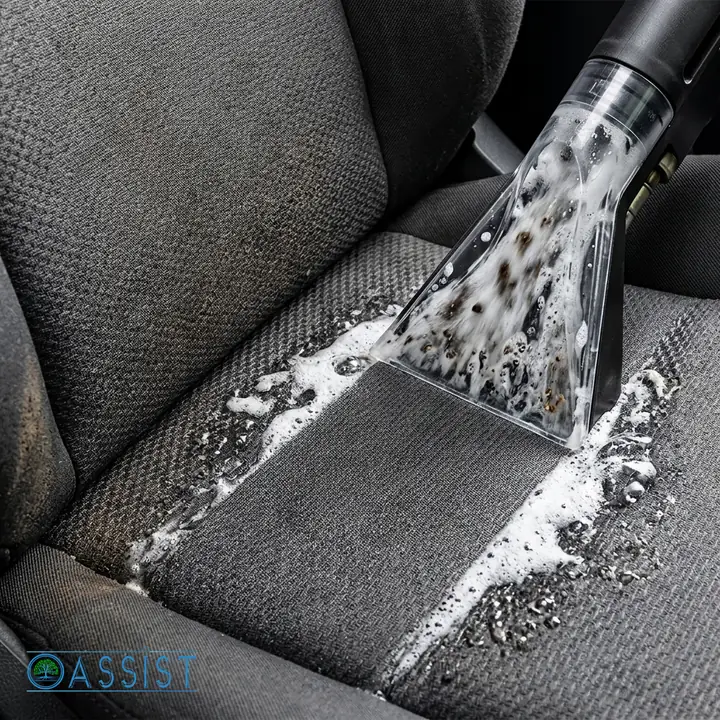
The only way to stop it is to take the water back out while the soil is still suspended in it, instead of letting it dry in place. That is extraction, and it is the one step a home kit does not have.
Fabric seats and leather seats are two different jobs
| Fabric | Leather | |
|---|---|---|
| Core problem | Absorbs. Liquid enters the foam and stays | Does not absorb, but dries out, loses oils and cracks |
| Water marks | Tide lines when it dries unevenly | Rare, but streaks if wiped unevenly |
| Mould risk | High while the foam stays damp | Low on the surface, but seams and perforations still hold moisture |
| Common mistake | Spraying far too much | Using a cleaner strong enough to lift the finish |
| Afterwards | Has to dry all the way through | Has to be fed with a protection oil |
A strong all purpose cleaner can take the coloured finish off leather, and once that is gone no amount of further cleaning brings it back.
How long do car seats take to dry in Malaysia?
Four to six hours, after a wet shampoo and extraction, and that is with ventilation. Not one hour, which is roughly when the surface starts feeling dry to the hand.
The method matters as much as the number. Leave the windows down by about 20 per cent for the whole of that time. A gap that size lets air move through the cabin without leaving the car open to rain or anyone walking past. Shutting the car at the two hour mark because the seat feels dry is the single most common way people turn a clean seat into a mouldy one.
Surface dry and dry through are not the same thing, and the gap between them is where mould starts. One quick test: if the fabric feels cool against the back of your hand, it is still holding water, because evaporation is what makes it feel cool.
How much does car interior cleaning cost in Malaysia?
Honestly, the search results on this are not much use, because the price depends on things a price list cannot see. Fabric or leather. How many seats. Whether there is urine, vomit or mould rather than ordinary soiling. Whether the headliner and floor carpets are included.
Our own answer is to quote from a photograph rather than publish a number that turns out to be wrong for your car. Send a picture on WhatsApp and the quote usually comes back the same day. There is no site visit and no charge for the quote.
Car seat and car interior work is currently available in the Klang Valley. Car cleaning in Johor Bahru is temporarily unavailable, including at the customer’s home, so if you are in Johor please ask before booking rather than assuming. Other Oassist services are unaffected.
Up to three infant car seats or strollers are cleaned free of charge with a car interior job. Both count toward the same three, so it can be two seats and a stroller, or three strollers.
These are among the worst items in any household. A baby seat is a fabric shell that collects milk, juice and worse, with straps and a deep bucket shape that are awkward to dry, and a stroller lives outdoors and then gets folded into a boot while still damp. Almost nobody cleans either until something is spilled on it.
Related reading
- Oassist car seat cleaning service, the fabric and leather packages and the free infant seat
- How to get rid of dust mites in a mattress, the same humidity problem in a mattress rather than a car
- All Oassist services, nine services and what each one includes
- Frequently asked questions, pricing, coverage and how quotes are given from a photo
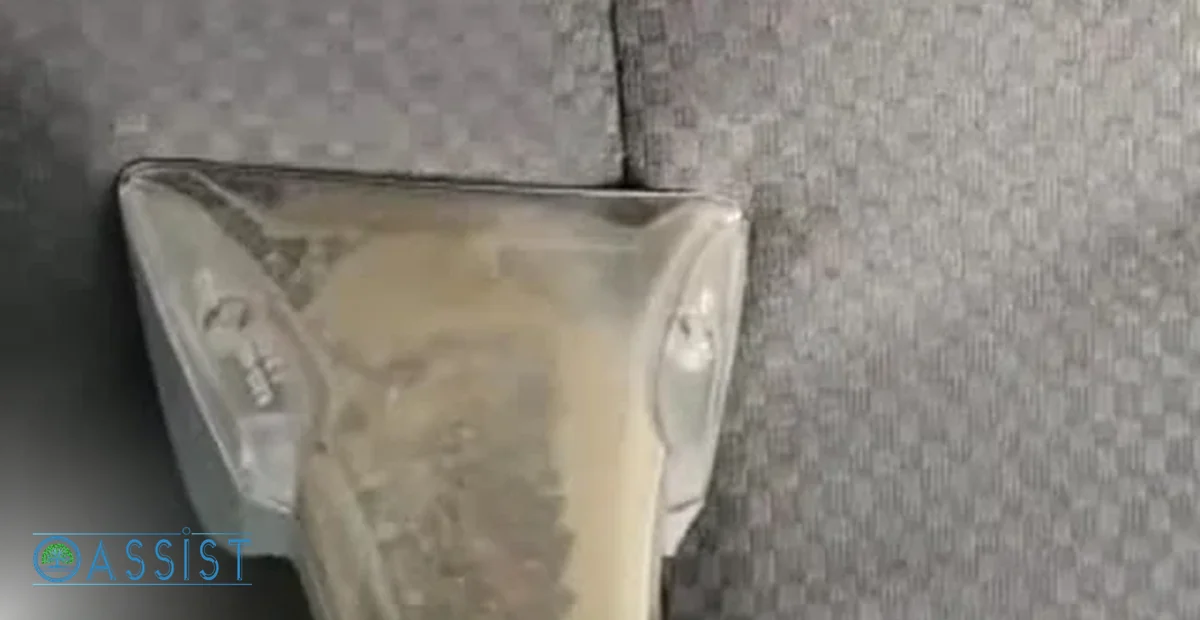
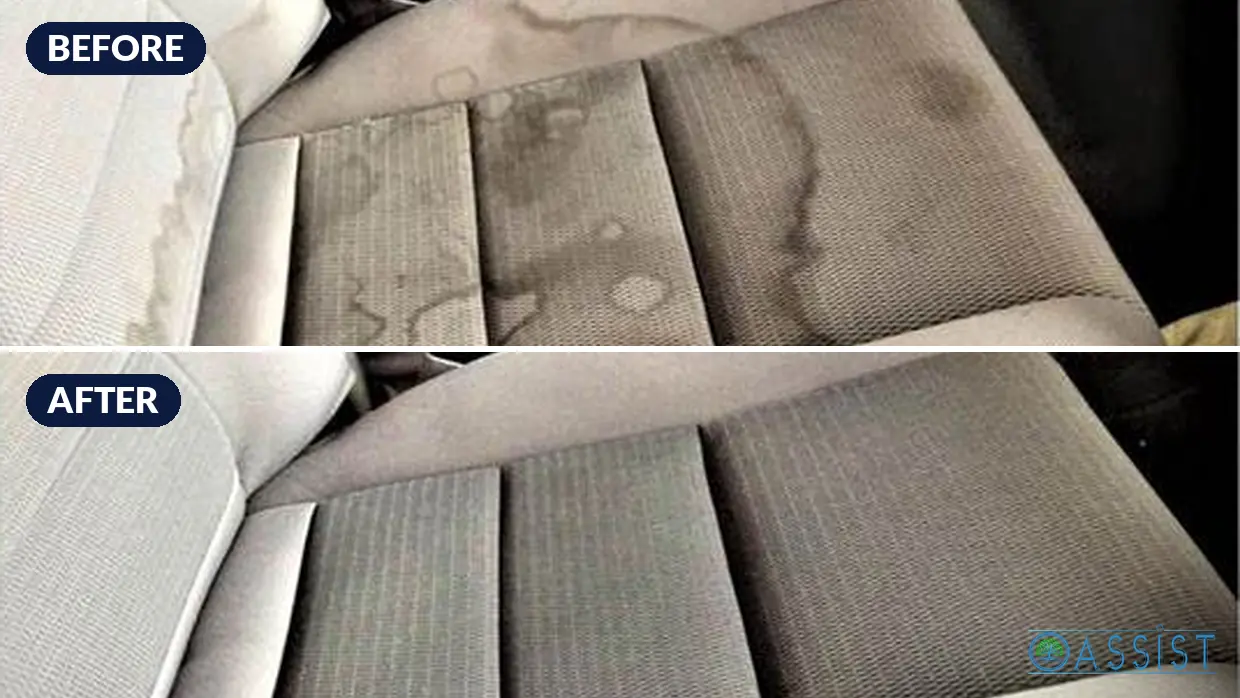
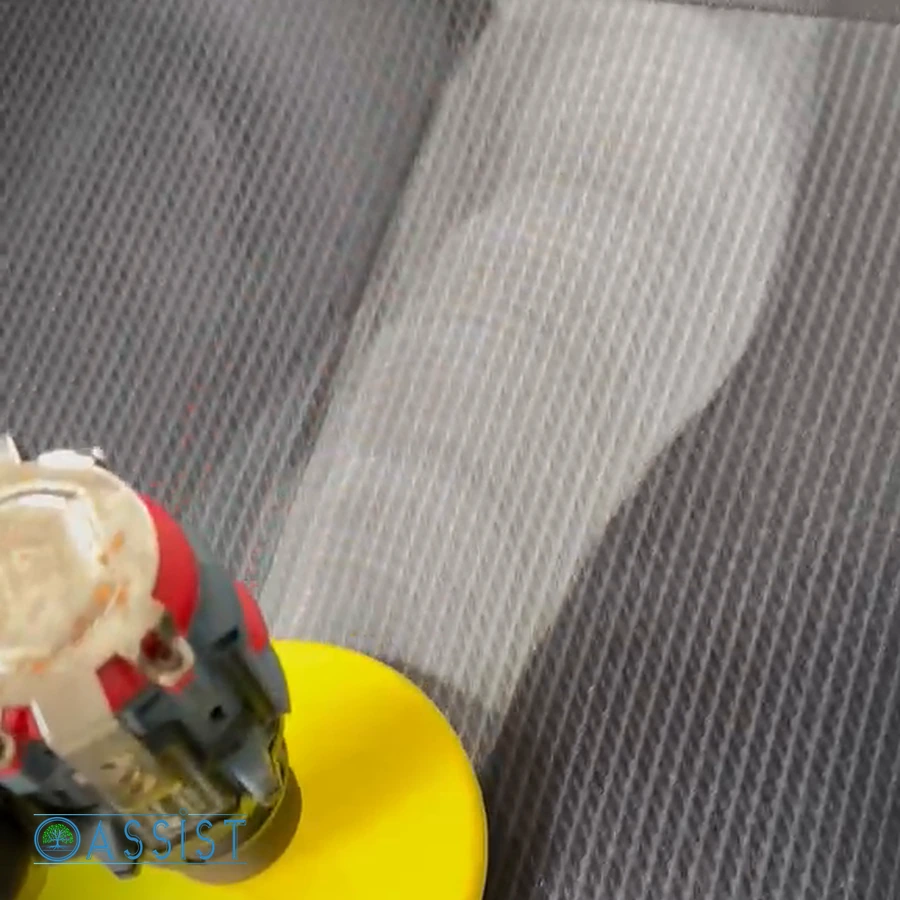
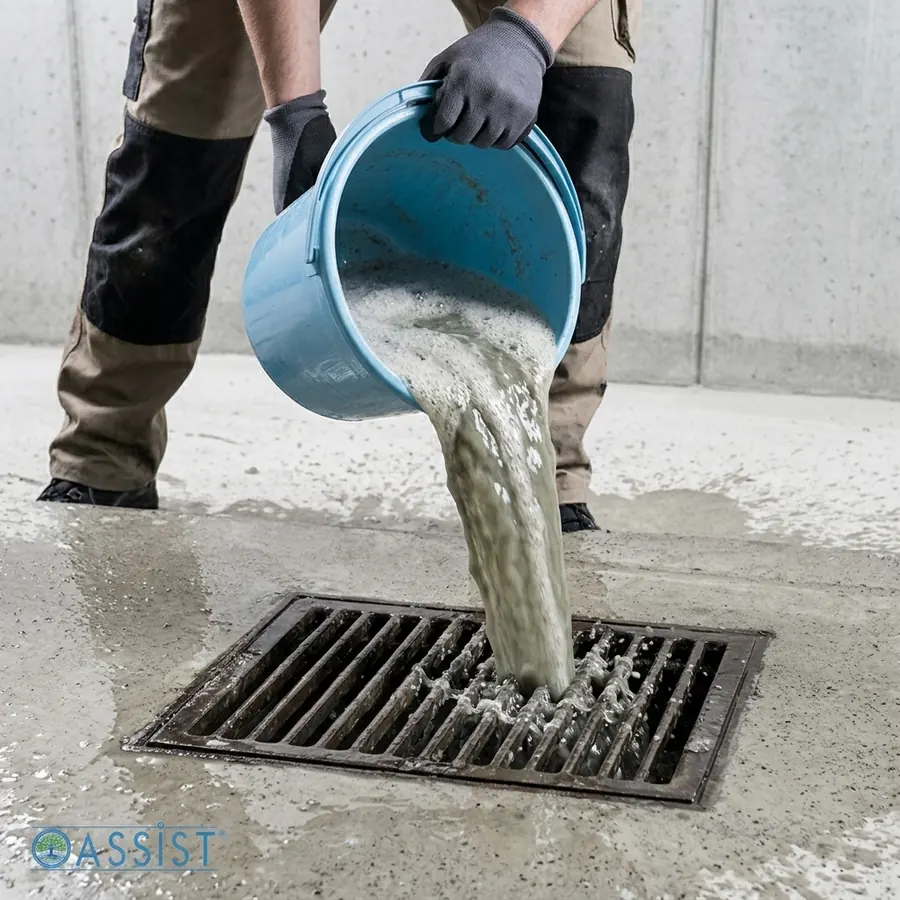
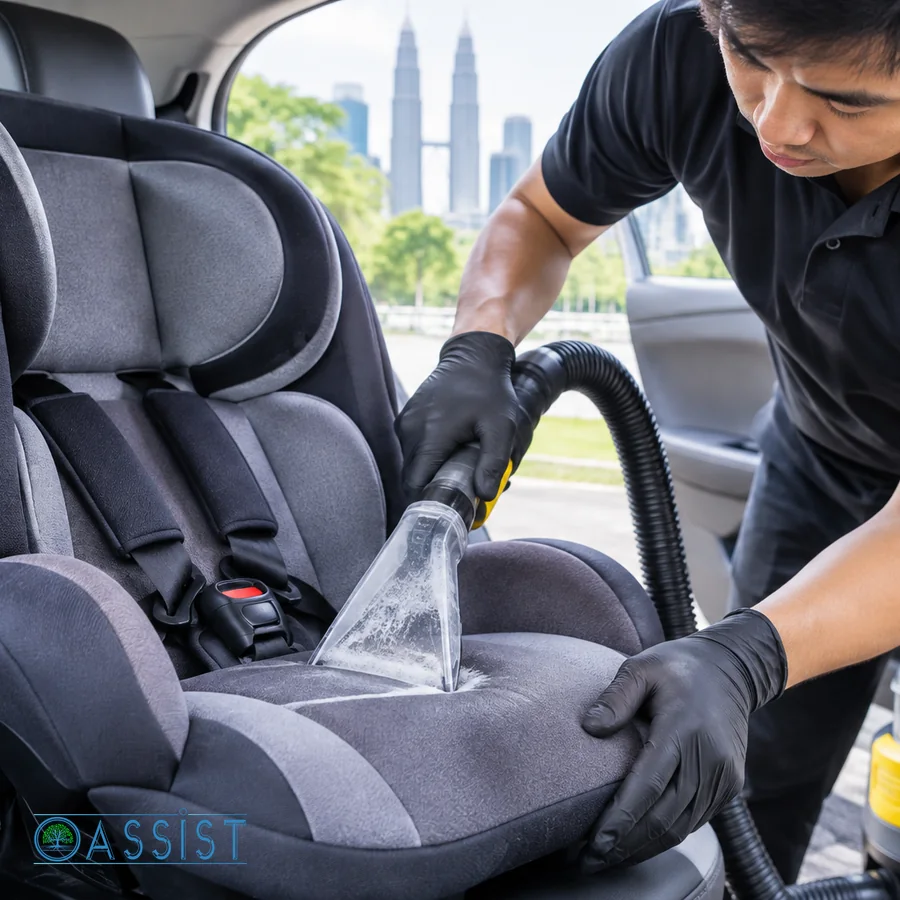
The before and after at the top of this page, and the photograph of the part cleaned seat, are from our own work. The remaining pictures illustrate the process rather than a particular job.
References
- Mould growth and the 70 per cent relative humidity threshold, Mould growth, Designing Buildings
- Temperature rise inside a parked vehicle, McLaren, Null and Quinn, Pediatrics 2005, 116(1), e109 to e112. The study and a summary from Stanford Medicine
- Alkaline salts from urine are hygroscopic, Scott Warrington, Locating Sources of Urine Odor, Cleanfax, 21 February 2017
- NADCC, a chlorine releasing disinfectant, in the UNICEF Supply Catalogue
- Chlorine gas released when sodium hypochlorite meets an acid, CDC MMWR
- Procedural standard for professional upholstery cleaning, including pre cleaning inspection and leather cleaning, ANSI/IICRC S300, second edition 2025
Frequently asked questions
Why do car seats go mouldy in Malaysia?
Because the foam inside stays wet after the surface feels dry. Most moulds need at least 70 per cent relative humidity, and inside damp foam it is close to 100 per cent regardless of the weather outside. Heat in a parked car dries the surface quickly and traps the moisture underneath, which is why mould often appears a week or two after a clean rather than before it.
Does parking in the sun dry a wet car seat?
It dries the surface, not the foam. A parked car gains about 3.2°F every five minutes and roughly 41°F over an hour, with 80 per cent of that rise in the first half hour, so the cabin gets very hot, but the heat reaches the top layer first and seals moisture below it. Open doors and moving air dry a seat properly. A closed hot car does not.
Why does the brown ring appear after I clean a car seat?
Because the soil was moved rather than removed. Water carries soil down into the foam, then brings it back to the surface as it evaporates and deposits it at the edge of the wet area. The ring marks how far you wet. It stops only when the water is extracted while the soil is still suspended in it.
How do I tell if the smell is the seats or the air conditioning?
Timing. If the smell is strongest in the first thirty seconds after starting the car and then fades, it is the air conditioning evaporator. If it is constant and gets worse on humid or rainy days, it is the upholstery.
Can I clean car seats myself?
Yes, for fresh surface soiling, and it is worth doing. It stops being enough once marks return as rings each time the seat dries, once a smell comes back with the weather, or once mould regrows in the same spot. Those are all signs the material is below the surface, where a towel cannot reach.
How long do car seats take to dry after cleaning?
Four to six hours after a wet shampoo and extraction, with ventilation. Keep the windows down by about 20 per cent for the whole of that time. The surface will feel dry long before the foam is, usually within the first hour, and closing the car at that point is the most common way a clean seat ends up mouldy.
Can mould be removed from car seats?
Yes, in most cases, and the seat is usually fine. The growth and the soil feeding it are cleaned out with a chemical made for car upholstery, then the fabric is treated with NADCC, a chlorine releasing disinfectant, and dried properly. Mould that is killed and left damp comes back.
Is leather cleaned the same way as fabric?
No. Fabric absorbs and has to be dried all the way through. Leather does not absorb but loses oils and cracks, so it needs a protection oil afterwards, and a cleaner strong enough to lift its coloured finish will ruin it permanently.
Do you clean infant car seats?
Yes, free of charge alongside car interior work. A baby seat is a fabric shell that collects milk, juice and spills and is awkward to dry properly, which makes it one of the worst items in most cars.
Not sure if it can still be saved?
Send a photo of the seat on WhatsApp. We will tell you honestly whether it needs cleaning, and quote from the photo, usually the same day.
WhatsApp UsBaca dalam Bahasa Melayu: Cara Cuci Kusyen Kereta Sendiri. 中文版:车用吸尘机和蒸汽机,真的洗得干净座椅吗?。